 Entrar
Las Vegas Grand Prix Cold Tyres: Why Night Hurts Grip
A desert night can drop the road below the tyre's working window. Here is what that does to the cars, and what our 2026 weather data can and cannot tell us.

Key takeaways
- A Formula 1 tyre grips only inside a narrow temperature window, and a cold night road can sit below it.
- The coolest 2026 race in GridRaces data was Canada, with air at 12.1 to 13.7 degrees Celsius and track at 16.3 to 19.1.
- Las Vegas qualifies on Friday 20 November and races on Saturday 21 November 2026, both at 20:00 local time.
- The GridRaces season has no Las Vegas session yet, so no cold-weather number for the Strip is claimed here.
Las Vegas Grand Prix cold tyres are a problem because a Formula 1 tyre only grips properly inside a narrow temperature window, and a desert night can sit below it. When the rubber is too cold, the car slides, the driver lifts, and the tyre heats itself by sliding, which is the opposite of what anyone wants. The race, round 21 of 23, starts at 20:00 local time on Saturday 21 November 2026.
Why do cold tyres lose grip?
Grip comes from rubber that is soft enough to key into the asphalt. A tyre gets there two ways: the road warms it, and the driver does, by working the carcass through braking, cornering and traction. In a hot race the road does most of the job, and the problem becomes the opposite one, overheating. At night in Nevada the road contributes little, so the driver has to supply nearly everything.
That is why a cold track feels like a different sport. Fewer laps with full confidence, more lifting before the braking zone, and a tyre that can switch from dead to alive in the space of one corner.
Cold also changes what a fast lap means. If the surface is cold, a driver pushing hard on an out-lap can overshoot the window the other way. Teams spend the weekend learning how many warm-up corners a set needs before it is worth the risk, and that number is not the same on Thursday as it is on Saturday.
Is Las Vegas the coldest race on the F1 calendar?
We cannot say that from our data yet, because the GridRaces season has no Las Vegas session to read. What we can do is measure the coldest race so far this year and treat it as a rough baseline.
According to the GridRaces weather sensor data, the coolest 2026 race by air temperature was the Canadian Grand Prix, round 5, where air temperature stayed between 12.1 and 13.7 degrees Celsius and track temperature between 16.3 and 19.1. The Chinese Grand Prix, round 2, was next, with air between 14.9 and 16.4 and track between 19.7 and 27.6. At the other end, the Monaco Grand Prix, round 6, peaked at 46.0 on track.
Those are readings from daytime races. Las Vegas races after dark, on a street circuit that has had no sun on it for hours. We are not going to predict a number, because forecasts for 21 November 2026 will move several times before then. The honest version is this: if the Strip is cold, the Canada and China numbers show the sort of conditions the cars have already handled this year, and the grid will have a reference point. If it is colder still, nobody in the paddock has 2026 data for it.
What makes the Strip Circuit hard on tyres?
The layout is a mix of very long straights and slow corners at the end of them. On a long straight the tyres cool down, because air blows over them and the load is light. Then a heavy braking zone asks them for full grip at once. The Las Vegas Strip Circuit is 6.201 km, and the Grand Prix runs 50 laps or two hours, whichever comes first, according to Formula 1.
So the work is rhythm. A driver who keeps heat in the tyre on the straight, by weaving or by braking a touch early, loses a few hundredths on that lap and gains them back on the next ten. It is a boring answer, and it is usually the right one.
What does it mean for qualifying and strategy?
Qualifying is Friday 20 November at 20:00 local time, so it is also run at night. The same rule applies: the lap that matters is often the second flying lap, not the first, because the first one warms the tyres for it. Expect teams to be deliberate about the gap between the out-lap and the push.
For the race, a cold track tends to reward the driver who can look after a set and punish the one who needs it perfect. A safety car also matters here: it slows the field, and tyres lose heat quickly behind it. If you want to see how stints actually played out this season, the telemetry page has pace and tyre data by round, and the wet tyres explainer covers what happens when water adds to the cold.
What should you watch in Las Vegas?
Three things. First, the opening laps of each run, where lap times usually drop as the tyres come in. Second, the restart after any safety car. Third, whichever driver complains on the radio about a tyre feeling "cold", which, if it comes early, tells you who is struggling to switch the rubber on.
For the wider picture, our Las Vegas preview has the schedule and form, and the standings show what is left to fight for with Antonelli already champion.
Our own take: Las Vegas will not be won by the fastest car on paper. It will be won by whoever treats the first three corners of every lap as a negotiation. If you disagree, make your call on the predict page and put your Energy on it.
- Canada air (C)
- 12.1-13.7
- Canada track (C)
- 16.3-19.1
- China air (C)
- 14.9-16.4
- Monaco track peak (C)
- 46.0
Frequently asked questions
Why do F1 tyres lose grip when it is cold?
The rubber is too stiff to key into the asphalt, and the road adds little heat. The driver has to heat the tyre through braking, cornering and traction, which is harder on a cold surface.
When is the Las Vegas Grand Prix 2026?
The race is on Saturday 21 November 2026 at 20:00 local time, 50 laps or two hours, whichever comes first. Qualifying is Friday 20 November at 20:00, per Formula 1.
What was the coolest F1 race of 2026 so far?
By GridRaces weather data, the Canadian Grand Prix, round 5, with air between 12.1 and 13.7 degrees Celsius and track between 16.3 and 19.1.
Sources
- Formula 1 Heineken Las Vegas Grand Prix 2026 — Formula 1
Related

Las Vegas Grand Prix 2026 Preview: Schedule and Form
Las Vegas Grand Prix 2026: race on Saturday 21 November, 20:00 local, 50 laps. Second in the drivers' standings is the fight to watch.
F1 Graining Explained: Why Las Vegas Tyres Are at Risk
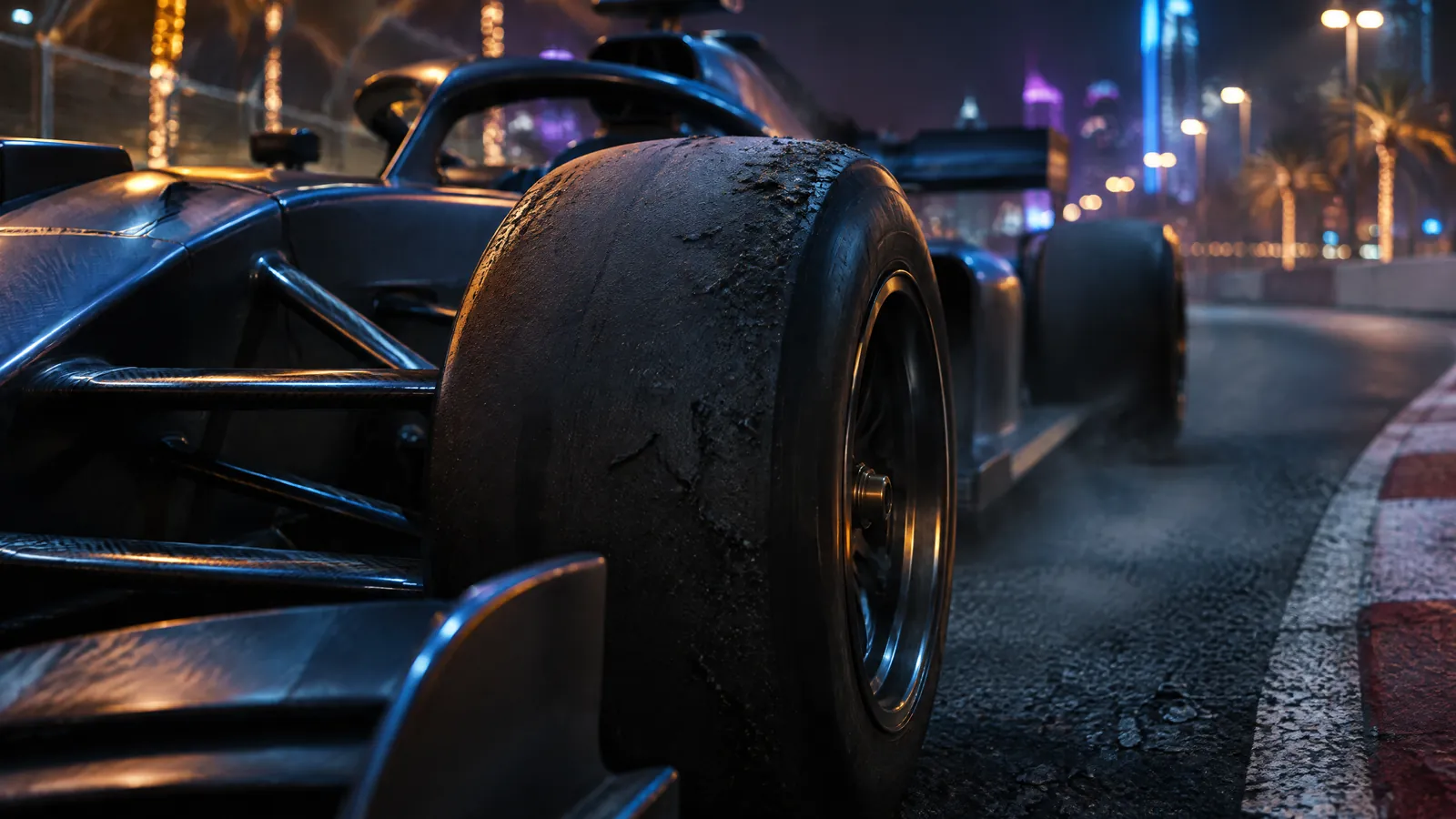
Graining turns grippy tyres into rubber crumbs. Here is why Las Vegas on Saturday night is built to cause it, and what teams can do about it.
Las Vegas Grand Prix Winners: Three Races, Three Stories
Verstappen won in 2023 and 2025, Russell in 2024. Three Vegas races, three different pole-sitters, and one corner that keeps deciding things.