 Entrar
F1 Graining Explained: Why Las Vegas Tyres Are at Risk
Cold asphalt, three long straights and a street that reopens to traffic every day: the 2026 Las Vegas Grand Prix is graining weather.
Key takeaways
- Graining happens when cold, stiff tyre rubber tears into small pieces that clump back onto the tread and cut grip.
- Pirelli's preview, as reported by Tyrepress, flags graining as a risk in Las Vegas, with air temperatures forecast at 10 to 15°C.
- Pirelli nominated the C3, C4 and C5, its softest trio, so the tyres warm up faster.
- Pirelli expects a one-stop to be quickest on paper and the undercut to be less effective.
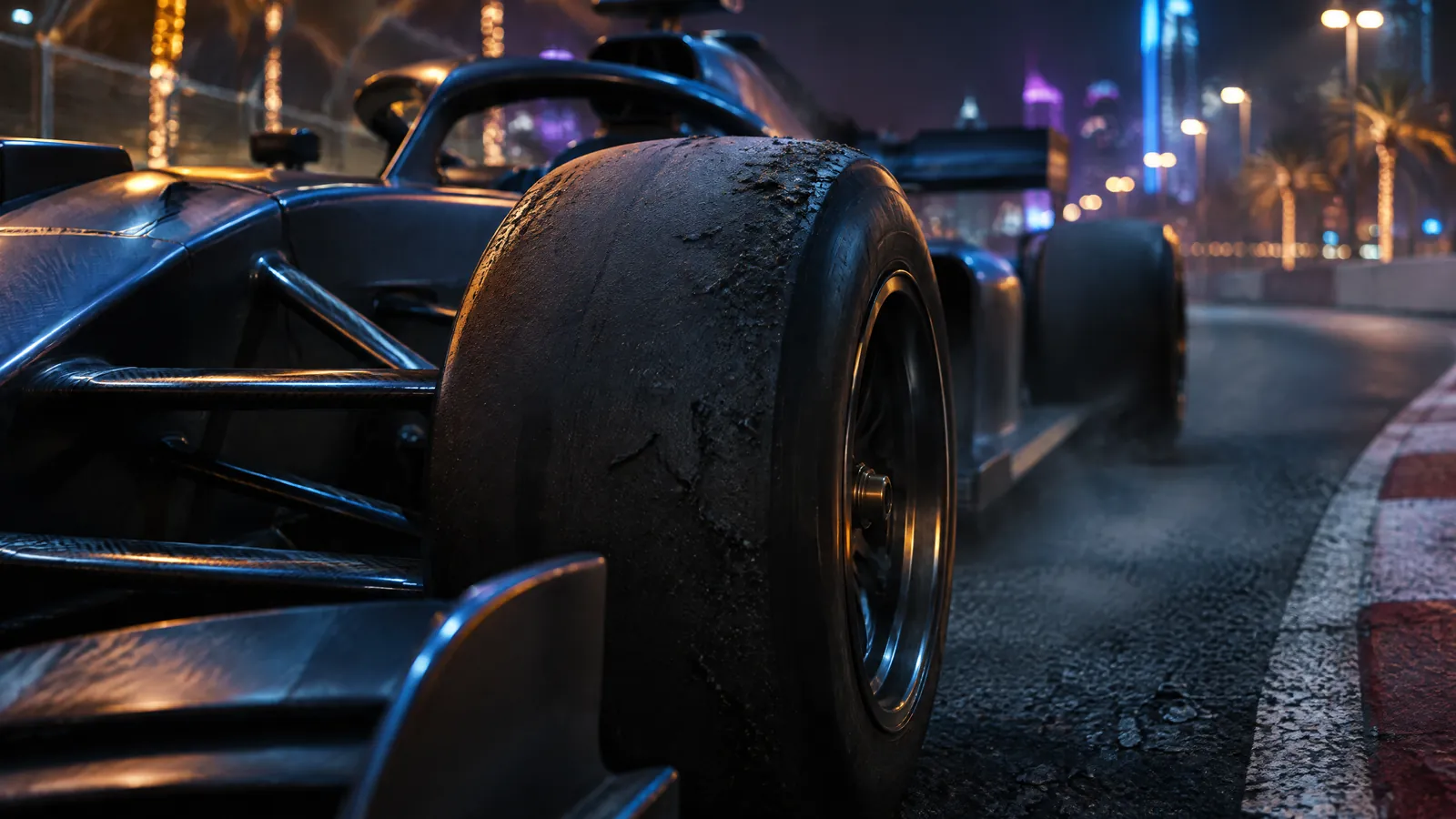
F1 graining is what happens when the surface of a tyre tears into tiny rubber fragments that roll into rough little balls and stick to the tread. The tyre still looks round and feels wrong: less front-end grip, a buzz through the wheel, lap times that go soft until the grains wear off. It is a cold-weather problem, and the 2026 Las Vegas Grand Prix, a night race on the Strip with air temperatures forecast between 10 and 15°C, is about as friendly to it as a race weekend gets. Pirelli names graining as a risk this week, according to its preview as reported by Tyrepress.
What is F1 graining, exactly?
Think of a tyre as a slab of sticky rubber that works by gripping the micro-texture of the asphalt. It needs heat to do that. Warm rubber is pliable: it flows into the texture of the road and holds on. Cold rubber is stiff. Ask a stiff surface for more than it can give, by sliding, braking hard or turning in before the tyre is ready, and instead of gripping it tears.
The torn pieces do not fly away. They roll, clump and press back onto the tread as small rough beads. Now the tyre is driving on its own crumbs, and the contact patch is smaller and less consistent than it was a lap ago. That is graining, in its simplified form. It is the cold cousin of blistering, which is what happens when a tyre gets too hot.
A cold tyre is not a weak tyre. It is a tyre that has not been convinced yet.
Why is Las Vegas a graining track in 2026?
Pirelli's preview, as reported by Tyrepress on 16 November 2026, lists the ingredients for the 6.201-kilometre Las Vegas Strip Circuit:
- Cold. Air temperatures are forecast between 10 and 15°C, with the desert dropping fast after dark.
- Long straights. Three full-throttle straights put little energy into the tyres, so heat is hard to hold on to.
- A road that resets. The street reopens to public traffic every day, so dust and sand keep resetting the grip level.
- Repairs. Minor resurfacing work has been done ahead of Turn 13 and on the approach to Turn 14.
Pirelli's summary, in paraphrase: cool asphalt and low initial grip leave the tyres open to mechanical degradation and graining, while the heavy braking zones at the end of the straights raise the risk of front lock-ups and flat spots.
What has Pirelli done about it?
It has picked the softest trio in the range. For Las Vegas and the Abu Dhabi finale, Pirelli nominated the C3, C4 and C5. One week earlier in Qatar it goes the other way, with the C1, C2 and C3 (Tyrepress). Softer rubber reaches its working temperature sooner, which is the whole idea.
One labelling note, because it trips people up. "Hard" is relative to what is nominated. The C3 is the hardest tyre on offer this weekend, so it wears the hard label, even though it would be one of the softer choices at a track like Qatar.
How does graining change race strategy?
Pirelli expects a one-stop to be the quickest route on paper, with all three compounds, the C5 included, able to play a part. It also expects the traditional undercut to be less effective, because a fresh tyre loses temperature along the long run from the pit exit before it reaches the higher-load corners. Last year, all three podium finishers one-stopped, starting on the Medium and finishing on the C3 Hard (Tyrepress).
Our reading, and it is a reading rather than a forecast: the undercut works by trading tyre age for fresh grip. When fresh also means cold, that trade gets worse. The team that treats its out-lap like a qualifying lap, not the one with the fastest pit stop, is the one most likely to win the strategy argument on Saturday night. For how the undercut has fared across the season, see our undercut explainer.
How can you spot graining during the race?
Three signs are worth watching for:
- A driver complaining on the radio about vibration or a lack of front-end grip.
- Lap times that fall away and then partly come back without a pit stop.
- A team choosing a longer, gentler first stint, or a very careful out-lap.
None of these proves graining on its own, and teams will not always say what they see. Still, together they are the pattern to look for. You can follow stint lap times on GridRaces Live while the race runs, then replay them in Telemetry afterwards. For the wider picture of why night racing hurts grip, read our explainer on Las Vegas cold tyres, and for the rest of the weekend, our five things to watch.
The race is scheduled to start at 04:00 UTC on 22 November 2026, which is Saturday night in Las Vegas. If the tyres behave, nobody will talk about graining. If they do not, it will be the only word on the radio.
Frequently asked questions
What is graining in F1?
Graining is when the surface of a tyre tears into tiny rubber pieces that roll into small beads and stick to the tread. The tyre then grips less until the beads wear away. It is most common when the tyre is too cold.
Which tyres will F1 use at the 2026 Las Vegas Grand Prix?
Pirelli nominated its softest three compounds, the C3, C4 and C5, for Las Vegas, according to Tyrepress.
Is a one-stop expected in Las Vegas in 2026?
On paper, yes. Pirelli anticipates a one-stop will be the quickest route, and all three nominated compounds could play a role.
Can a grained tyre recover?
Often it can, once the surface wears and the tyre gets into its working temperature, but that can cost several laps. That is why teams watch out-laps and early stints so carefully.
Sources
Related
Las Vegas Strip Circuit Guide: How One Lap Really Works
A guide to the 6.201 km Las Vegas Strip Circuit: the cold opening sector, the Strip straight and the braking zone that decides the lap.
Las Vegas Grand Prix Saturday Night: Why F1 Races Then
Las Vegas races Saturday at 20:00 local, early Sunday in Europe and Brazil. Why F1 picked that slot, and every session time for 2026.

Las Vegas Grand Prix Cold Tyres: Why Night Hurts Grip
Why cold tyres lose grip on the Las Vegas Strip, with 2026 weather data from the coolest races so far.