 Entrar
Esta página está disponível só em inglês. A versão em português depende de revisão de um advogado, não de tradução.
ExplainersF1 Red Flag Rules Explained: What Teams Can Change
A red flag wipes out gaps, opens the pit lane to fresh tyres and rebuilds the race from a standing start. Here is how it works.
Key takeaways
- Under a red flag the cars return to the pit lane and line up behind the Safety Car in the order held at the last point where every position was known.
- Teams may fit fresh tyres and repair the car under a red flag, but cannot change its basic setup.
- In dry conditions the default restart is a standing start, allowed since 2018; wet or low-visibility restarts are rolling.
- Detailed procedures here follow 2023 PlanetF1 reporting, so check the FIA's current regulations.
The F1 red flag rules come down to one idea: when the track is unsafe, everything stops, the cars return to the pit lane, and the race is rebuilt from the order the field held when the flag came out. Teams may then fit fresh tyres and carry out repairs before a restart, which is usually a standing start in the dry. That is exactly what happened in the Mexico City Grand Prix on 1 November 2026, when Valtteri Bottas's suspension failure brought out the flag and reshuffled the afternoon.
Rules note: the detailed procedure below follows PlanetF1's explainer, published in 2023, and its follow-up on that year's restart tweak. The sporting regulations are revised often, so treat the numbers as the framework and the FIA's current regulations as the final word.
What happens when the red flag comes out?
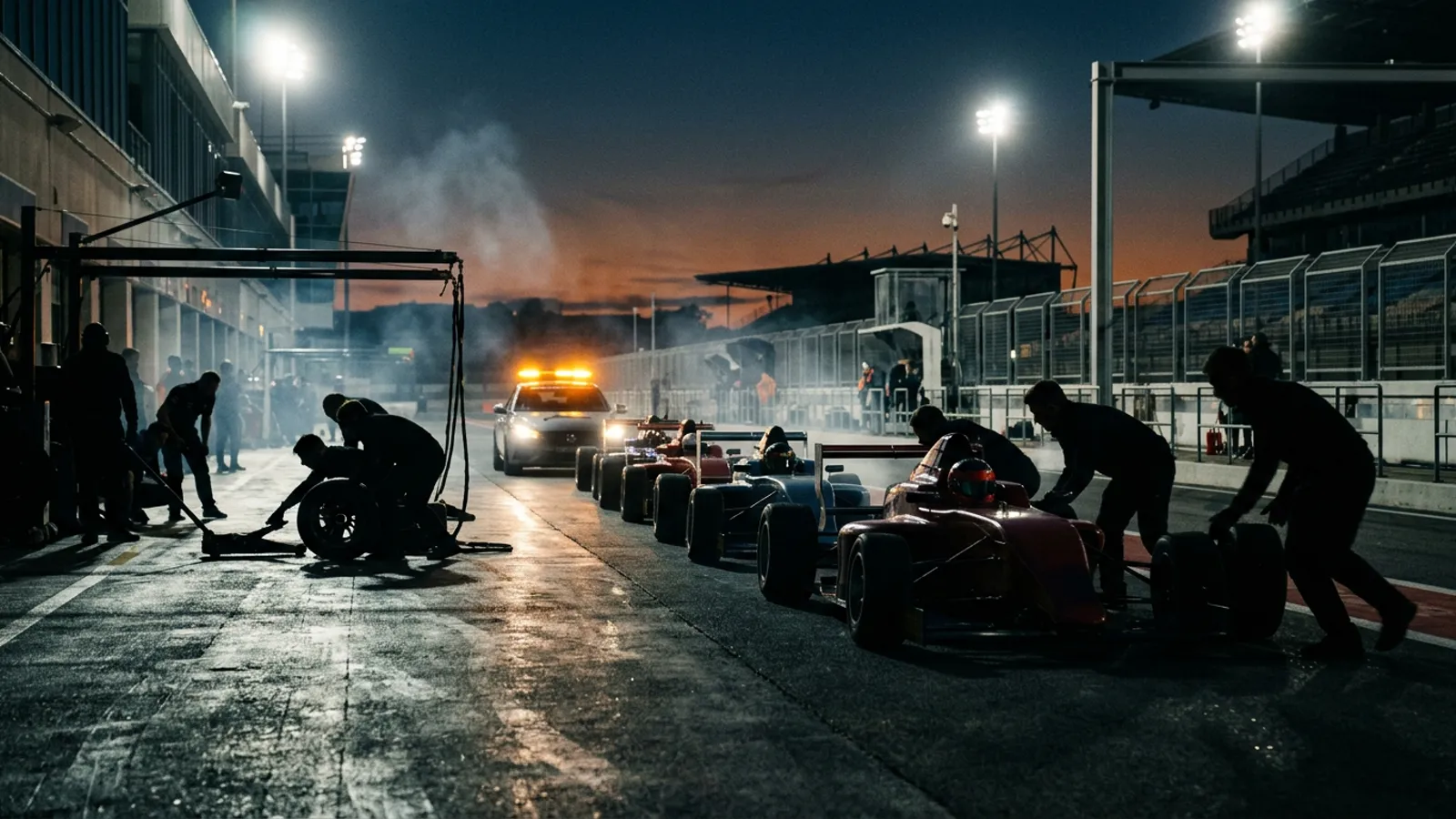
The pit exit closes and the race is suspended. Drivers slow down and return to the pit lane. Cars then line up single file behind the Safety Car, in the order they held at the last point where every car's position was known. A car that was blocked by the incident rejoins the queue once the track is clear.
If the flag comes so early that nobody has completed a sector, the order falls back to the original grid, minus any retirements. PlanetF1 cites Silverstone in 2022 as the example.
Can teams change tyres under a red flag?
Yes, and this is the part that changes races. While the cars sit in the pit lane, teams may fit fresh tyres, repair damage and adjust items such as brake ducts, radiator ducts and the front wing. Cockpit comfort settings can change, but the car's basic setup cannot. It is the closest thing F1 has to a free pit stop, which is why a well-timed flag can feel like a gift to the leader and a gut punch to anyone who stopped just before it.
For a longer look at what is frozen and what is not, see our parc fermé explainer.
How does an F1 red flag restart work?
PlanetF1 describes a countdown. Five minutes before the restart, wheels must be fitted and tyre blankets removed, or the car risks a penalty. At two minutes, cars between the Safety Car and the leader, plus lapped cars, do a reduced-speed lap and rejoin without overtaking. At one minute, engines fire, and the pit lane's fast lane must be cleared when the 15-second signal sounds. Race Control also confirms whether the restart is standing or rolling.
Standing start or rolling start?
In dry conditions the default is a standing start, allowed since 2018. The Safety Car leads the field round for one lap, then pulls in, and the cars form up on the grid for a full start sequence. A rolling start is used when conditions are unsafe for a standing one, such as heavy rain or poor visibility. The cars circulate behind the Safety Car until it turns off its lights, and racing resumes at the end of that lap.
The standing restart has a weakness: cold tyres. After the Australian Grand Prix produced three red flags in 2023, drivers complained, and the FIA changed the procedure for the Baku weekend so the Safety Car leaves the pit lane 30 seconds before the cars, lights off, letting the leader set the pace and build tyre temperature. Whether that adjustment became permanent is something to check in the current regulations.
Why the Mexico City restart mattered
According to our Mexico City result report, Bottas hit the barrier at the end of the main straight, the race was red-flagged for barrier repairs, and the restart was a standing one. Lewis Hamilton passed Charles Leclerc for second and went after Max Verstappen at Turn 1, where the two touched; the stewards took no further action. Verstappen kept the lead and won.
That is the lesson of every red flag: the gaps that took an hour to build disappear in a pit lane queue. A leader's advantage is wiped, tyres are fresh for everyone, and the first corner after the green flag becomes the race.
What a red flag means for strategy
Teams plan around the possibility. A driver who has not yet stopped gets a fresh set without losing track position, while one who pitted a lap earlier has lost that advantage. A red flag rewards timing as much as speed.
Watch how the order changes in real time on our live page, and join GridRaces to put your Energy on the picks that survive a restart when the next red flag arrives.
Frequently asked questions
Can F1 teams change tyres during a red flag?
Yes. Teams can fit fresh tyres and carry out repairs while cars wait in the pit lane, but they cannot change the car's basic setup.
How does an F1 red flag restart work?
Cars queue behind the Safety Car in their running order, follow a countdown, and restart with a standing start in the dry or a rolling start when conditions are unsafe.
What happens if a red flag comes on the first lap?
If no sector was completed, the order reverts to the original grid minus retirements, as at Silverstone in 2022.
Sources
Related

F1 Safety Car 2026: 13 Deployments Across 17 Rounds
GridRaces race control data: 13 safety car deployments in 17 rounds of 2026, in 9 races. Five came in the first ten laps. What it means for Mexico City.
F1 Grid Penalty Explained: Why Bottas Got 50 Places
Valtteri Bottas starts Mexico City from the back after a 50-place penalty. Here is how F1 grid penalties and power unit allowances work.
Mexico City Altitude F1: How Thin Air Changes the Cars
Mexico City's 2,200 m altitude thins the air, trims downforce and heats brakes and power units. Here is what changes for F1 cars on Sunday.