 Entrar
Esta página está disponível só em inglês. A versão em português depende de revisão de um advogado, não de tradução.
AnalysisF1 Pit Stop Times 2026: Mercedes Half a Second Faster
Seventeen rounds, 603 logged stops, one clear winner in the pit lane, and a tail of slow ones that tells the real story.
Key takeaways
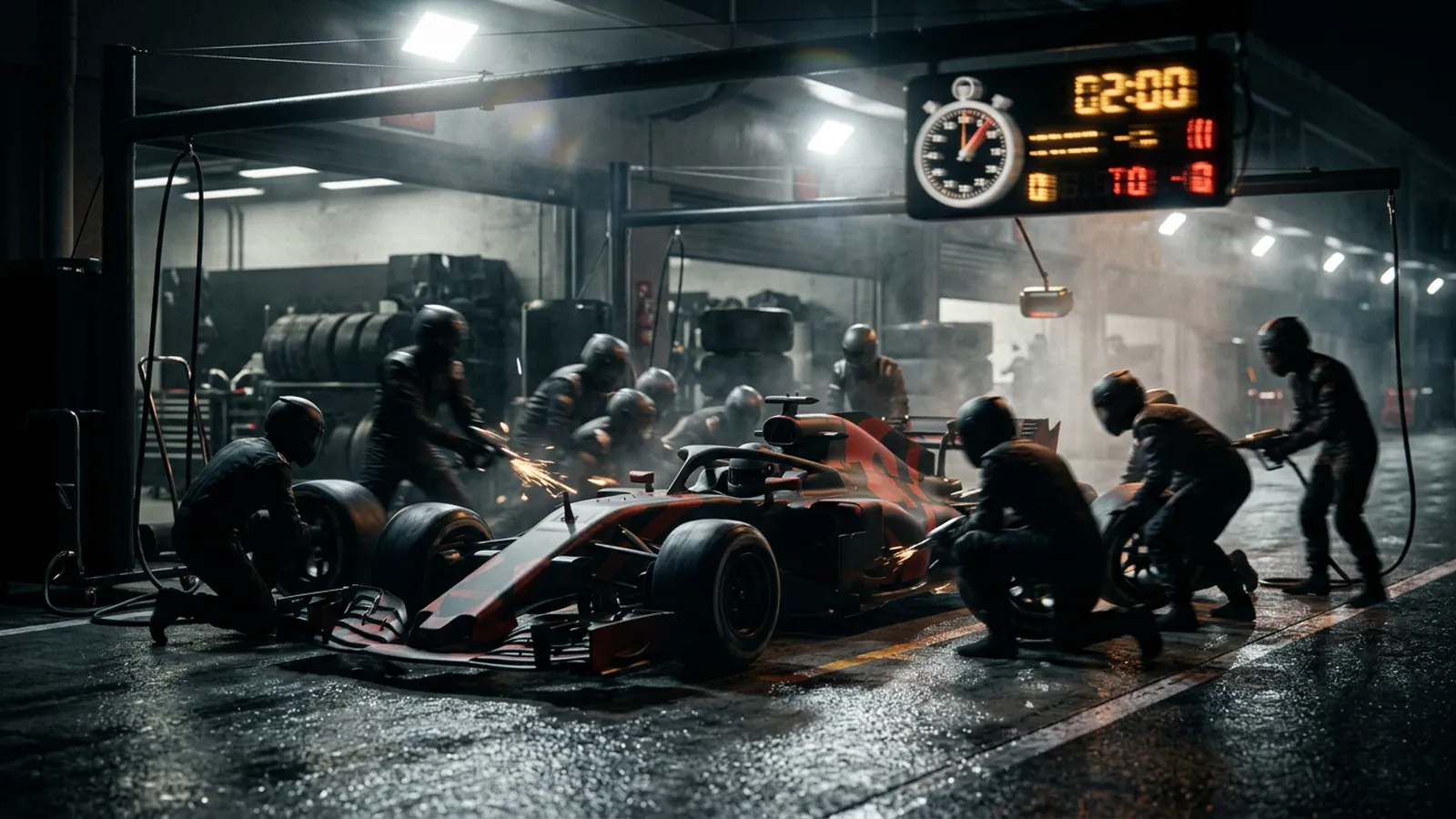
- Mercedes' median pit stop in 2026 is 0.51 seconds faster than the median stop at the same race (rounds 1 to 17, GridRaces data).
- Red Bull are second at 0.27 seconds under; Cadillac are slowest at 1.06 seconds over, with Haas at 0.49 over.
- Ferrari have a top-three median stop but a mean 0.54 seconds over, pointing to a tail of slow stops rather than slow crews.
- Only Mercedes and RB F1 Team have a mean stop faster than the race median.
F1 pit stop times 2026 have a clear leader: Mercedes. Across the first 17 rounds of the season, GridRaces data shows their typical stop ran 0.51 seconds quicker than the median stop at the same race, the best of the 11 teams. Red Bull were next at 0.27 seconds. At the other end, Cadillac were 1.06 seconds slower than the median. Half a second sounds like nothing until you remember how many strategies hinge on an undercut that lands by a few tenths.
How we measured F1 pit stop times in 2026
Raw pit stop times are a trap. In the GridRaces data the median logged stop at the Dutch Grand Prix (Round 12) was 18.06 seconds. At the Spanish Grand Prix (Round 14) it was 31.44. A team that happened to pit more often in Spain would look slow for reasons that have nothing to do with the crew.
So we did this. For every logged stop in rounds 1 to 17 of the 2026 season, we took its duration and subtracted the median duration of all stops at that same race. A negative number means faster than a typical stop that day. Then we took each team's median across the season.
We kept stops under 40 seconds: 603 of the 689 logged. The 86 longer entries are almost certainly something else (repairs, penalties, a red flag) and would make everyone look worse in a way that says nothing about practice and choreography. We have not classified them one by one, so treat that cut as a judgement call, not a law of physics.
Which team is fastest in the pit lane?
Mercedes, by a distance that is small in absolute terms and large by pit-lane standards. Their median stop was 0.51 seconds under the race median across 55 stops. Red Bull sit second at 0.27 under across 52. Ferrari are third at 0.16 under (59 stops) and McLaren fourth at 0.12 under (54).
Then comes a cluster that is basically the field. RB F1 Team, Aston Martin, Alpine, Audi and Williams all sit within 0.04 seconds of the median. If you are wondering whether one of them is secretly quick, the data says: no, and also not slow.
At the bottom, Haas are 0.49 seconds slower than the median and Cadillac are 1.06 slower, across 59 stops. A first-season crew is learning in public, and one second a stop is roughly what that tuition looks like. The joke, if you want one, is that a team new to the grid has found the one place where a stopwatch cannot be talked into believing in them.
Where the median lies to you
The median is the crew you meet on a good day. The mean is the crew you meet on Sunday. The gap between the two is where the story is.
Mercedes' mean is 0.31 seconds under the race median, so their slow stops are not dragging the average. Only one other team, RB F1 Team at 0.06 under, has a negative mean. Everyone else is above zero.
Ferrari are the interesting case. Their median is 0.16 under, one of the best in the field, but their mean is 0.54 over. That is a 0.70-second gap between a typical stop and the average one, which means a handful of slow stops are doing real damage. Aston Martin show the same pattern more extremely: a median basically on the line (0.02 under) and a mean of 1.19 over. Williams, with 64 stops, the most of any team, have a mean of 1.05 over against a median of 0.01 under.
Read that as an execution problem, not a speed problem. These crews can do a normal stop in a normal time. The trouble is the occasional one that goes wrong, and an occasional slow stop is the kind of thing that turns a good strategy call into a bad afternoon. It also lines up with how few safety car periods we have had in 2026, where a slow stop in green-flag running costs you more because nothing neutralises it.
What is the case against reading too much into this?
Three caveats, in descending order of importance.
First, sample size. Fifty-odd stops per team is enough to spot a half-second gap, not enough to rank teams separated by a few hundredths. Do not take the order of RB F1 Team, Alpine, Audi and Williams seriously.
Second, we are using the logged duration, which depends on how the timing source defines a stop. At the same circuit it is a fair comparison. Across circuits it is not, which is exactly why we normalised by race.
Third, a fast pit stop is one input into a result, not the result. Mercedes have still lost races this season, for reasons we looked at in our breakdown of their six defeats. Nobody has ever won a title on stopwatch alone.
Verdict: what half a second is worth
Our view: Mercedes' pit-lane advantage is real, modest, and underrated. Half a second will not win a race on its own, but it is the margin that makes an undercut stick when two cars are separated by tenths, and Mercedes can lean on it when the track gives them nothing else. The bigger story may be Ferrari, who have the speed to match Mercedes and lose it to a few bad stops. Fix the tail and that gap closes.
Interlagos is next, in Round 20. We will check whether the pattern survives a new pit lane in São Paulo. Meanwhile, you can explore the underlying numbers in the telemetry hub, check where each team stands in the championship standings, and browse more data stories in our analysis archive. For how long a tyre actually lasts before a stop is needed, see our hard tyre stint length analysis.
- Stops analysed (rounds 1-17)
- 603
- Best team median vs race median
- -0.51 s
- Slowest team median vs race median
- +1.06 s
- Teams compared
- 11
| Pos | Driver | Median vs race median (s) |
|---|---|---|
| 1 | Mercedes | -0.51 |
| 2 | Red Bull | -0.27 |
| 3 | Ferrari | -0.16 |
| 4 | McLaren | -0.12 |
| 5 | RB F1 Team | -0.04 |
| 6 | Aston Martin | -0.02 |
| 7 | Alpine | -0.01 |
| 8 | Audi | -0.01 |
| 9 | Williams | -0.01 |
| 10 | Haas | +0.49 |
| 11 | Cadillac | +1.06 |
Frequently asked questions
Which F1 team has the fastest pit stops in 2026?
Mercedes. Across rounds 1 to 17, their median stop was 0.51 seconds quicker than the median stop at the same race, ahead of Red Bull at 0.27 seconds.
How do you compare pit stop times between different circuits?
Pit lane lengths differ, so we subtract the median stop at each race from every stop, then take each team's median across the season. That removes the track effect.
Are slow pit stops a problem for Ferrari in 2026?
Their typical stop is fast (0.16 seconds under the race median) but their average is 0.54 over, which points to a handful of slow stops rather than a slow crew.
Sources
- GridRaces pit stop data, 2026 rounds 1-17 — GridRaces
Related
F1 Qualifying Pace 2026: Ferrari Lead Q1, Mercedes Win
Ferrari leads Q1 pace in 2026 but Mercedes took 11 poles and 11 wins from the same grid slot. GridRaces data explains.
Mercedes Qualifying Pace 2026: 0.074s From Pole on Average
Mercedes' quicker car averaged 0.074s off pole across Rounds 10-15, the closest of any team. Sepang cast doubt on why. Singapore will help answer it.
Antonelli vs Russell 2026: Singapore Tests the Mercedes Gap
Antonelli vs Russell through 15 rounds: eight wins to three, no DNFs to two, level on poles. What the Singapore GP back-row start means for Mercedes.