Rafael Camara Debut Data: Just 0.12s Off Bearman on Softs
Haas keeps its rookie for Las Vegas, and the Brazil lap times say the gap to Oliver Bearman lived on intermediates, not slicks.
Key takeaways
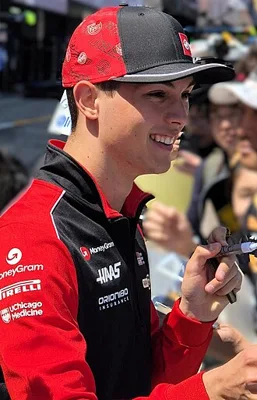
- Rafael Camara finished his Brazilian GP debut 20th, two laps down, after starting 11th.
- On soft tyres his median lap was 0.119s and 0.104s slower than Oliver Bearman's in two stints.
- On intermediates the gap was 1.159s early and 1.428s late, which is where the result was lost.
- Camara was 0.221s faster than Bearman in Q1 but 2.385s slower in Q2, in changing conditions.
- Haas confirmed on 16 November 2026 that Camara races in Las Vegas, with Ryo Hirakawa in Bearman's car for FP1.
The Rafael Camara debut in the 2026 Brazilian Grand Prix ended 20th and two laps down, but the GridRaces lap data tells a more useful story. On soft tyres he was only about 0.12 seconds a lap slower than Haas team-mate Oliver Bearman, while on intermediates the gap grew past a second. Haas confirmed on 16 November 2026 that Camara keeps the car for the Las Vegas Grand Prix, so the question is which of those two numbers he takes to the Strip.
Rafael Camara debut: the result and the context
Camara started 11th, finished 20th and last of the classified runners, and completed 69 laps to the winner's 71. Bearman started sixth, finished 17th and completed 70. Neither scored. By the end of lap 1 Camara was 16th and Bearman 10th, so both lost places in the opening mile, Camara five of them.
The context matters. According to The Race, Camara was called up at the start of that week after Haas parted with Esteban Ocon, and he had never driven the 2026 car. Haas team principal Ayao Komatsu said the debut came in "extremely challenging conditions". Camara had been named as a 2027 Haas driver in October, per Formula1.com.
Where the gap to Bearman actually sat
We took median green-flag lap times in four windows, leaving out pit-in, pit-out and deleted laps. Camara's stops came on laps 15, 49 and 59, so the windows sit inside his stints. Camara first, Bearman second, gap in brackets:
- Laps 4-13, intermediates: 89.471s v 88.312s (1.159s)
- Laps 20-46, softs: 77.496s v 77.377s (0.119s)
- Laps 52-58, softs: 75.910s v 75.806s (0.104s)
- Laps 63-68, intermediates: 87.277s v 85.849s (1.428s)
Camara's debut was a tenth-of-a-second story on slicks and a second-and-a-bit story on intermediates. Scott Mitchell-Malm of The Race reached a similar conclusion, putting the soft-tyre deficit at about a tenth and noting the gap grew in both intermediate stints. Our medians agree with him.
Qualifying: quicker in Q1, lost in Q2
Camara beat Bearman in Q1, 92.809s to 93.030s, a margin of 0.221s. In Q2 the picture flipped: Camara set 91.515s and Bearman 89.130s, a 2.385s gap. Camara classified 13th and Bearman 8th. Rain fell during the session and Camara had two offs, according to The Race, so the Q2 number says as much about timing as about talent. Interlagos weather changes its mind more often than a pit wall does, and a rookie who has never driven the car is the last person to find the window.
The counter-argument: small samples and a compromised team-mate
Be careful with all of this. The windows hold between 6 and 27 laps. Bearman's race was disrupted too: The Race says he spent time in traffic, and his first stop took 39.773s against Camara's 25.007s, a swing of 14.766s in the pit lane. After that the stops converged. Camara's were 25.007s, 24.409s and 25.332s; Bearman's were 39.773s, 27.554s and 25.357s. Camara's best lap, 74.369s, was also 0.333s slower than Bearman's 74.036s. A tenth on softs is encouraging. It is not a coronation.
How to read the intermediate gap
Intermediates are the tyre a rookie has the least feel for, because wet running is mostly about confidence, and a debut weekend that included two qualifying offs is a poor place to find it. The Race singles out Camara's opening and closing intermediate stints as the weakest parts of his race, and says the closing one came when there was nothing left to play for. Our numbers fit that reading: the gap grew from 1.159s in the opening window to 1.428s in the closing one, an extra 0.269s a lap once the result was effectively settled.
That is a pattern worth separating from raw speed. A driver who is a tenth off on softs and over a second off on intermediates is not slow, he is cautious on a surface that punishes brave guesses. Cautious is fixable in a way that slow is not.
What to watch in Las Vegas practice
- The first soft run against the 0.12s benchmark. Hirakawa takes Bearman's car in FP1, so the first clean team-mate comparison arrives after that session.
- Lap 1. Camara lost five places on the opening lap in Brazil, from 11th to 16th. A cleaner start would be worth more than a tenth of pace.
- Tyre warm-up. Night running on a street circuit rewards drivers who get heat into the rubber early, which is a skill rookies learn only by doing it.
What it means for Las Vegas
Las Vegas is new to Camara, who said as much in Haas's announcement, and Ryo Hirakawa takes Bearman's car for FP1. If the weekend is dry, the soft-tyre number is the relevant one, and the night-time cold-grip problem in our Las Vegas cold tyres explainer is the bigger test than raw pace.
Beyond Vegas things get complicated. The Race notes Camara leads the Formula 2 standings by seven points over Nikola Tsolov, and Qatar and Abu Dhabi both have F2 on the bill, which makes racing both nearly impossible.
Judge him on slicks. If the gap stays near a tenth in Vegas, Haas has a rookie who is closer to Bearman than his Brazilian result suggests. For the earlier chapter, read our Camara debut news report and the Bearman vs Ocon ledger. The championship picture sits on the standings page, and the lap-by-lap Brazil data is in telemetry.
- Grid
- 11th
- Finish
- 20th
- Laps completed
- 69 of 71
- Position after lap 1
- 16th
| Metric | CAM | BEA |
|---|---|---|
| Laps 4-13 (inters) | 89.471 | 88.312 |
| Laps 20-46 (softs) | 77.496 | 77.377 |
| Laps 52-58 (softs) | 75.91 | 75.806 |
| Laps 63-68 (inters) | 87.277 | 85.849 |
Frequently asked questions
How did Rafael Camara do on his F1 debut?
He started 11th and finished 20th and last of the classified runners, two laps down, in the 2026 Brazilian Grand Prix.
Was Rafael Camara slower than Oliver Bearman in Brazil?
On median soft-tyre laps by about a tenth of a second, and on intermediates by more than a second, per GridRaces lap data.
Will Rafael Camara race in Las Vegas?
Yes. Haas confirmed on 16 November 2026 that he will drive in the Las Vegas Grand Prix.
Sources
Related
Bearman vs Ocon 2026: Haas Teammate Battle in 17 Rounds
Bearman outscored Ocon 19 to 7 at Haas across 17 rounds. What the data shows.
Rafael Camara F1 Debut: Haas Drop Ocon for Brazil GP
Haas confirm Ocon is out for 2026. Rafael Camara debuts at the São Paulo GP.
F1 Qualifying Evolution 2026: How Much Faster Is Q3?
Across 19 rounds the best Q3 lap beat the best Q1 lap by 1.09s on average. Belgium gained 1.50s, Canada 0.80s.