 Entrar
Esta página está disponível só em inglês. A versão em português depende de revisão de um advogado, não de tradução.
AnalysisHadjar US GP 2026: Third on the Grid, Minus 8 on Lap One
Red Bull's Isack Hadjar has only his second top-three start of 2026. His lap-one record says the first corner is where it could go wrong.
Key takeaways
- Isack Hadjar qualified third for the 2026 US GP, 0.215s behind pole and 0.036s behind Verstappen, per RaceFans.
- In GridRaces data for rounds 1 to 17, Hadjar averages a 9.7 grid slot and a 6.3 classified finish over 14 starts.
- His net lap-one change is minus 8 places; Leclerc, starting fourth, is plus 14 over 17 starts.
- The lap-one measure includes contact and the order cars line up in, so it is a warning, not a verdict.
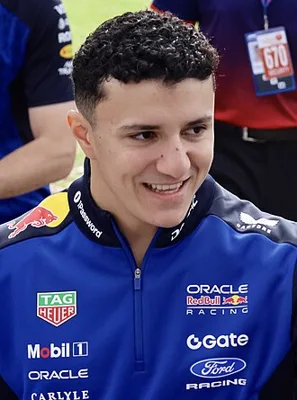
Isack Hadjar starts the 2026 US Grand Prix third on the grid, and the Hadjar US GP 2026 story comes down to one lap. In the GridRaces results for rounds 1 to 17, the Red Bull driver has lost a net 8 places on lap one across 14 starts. Austin is only his second top-three start of 2026, and the first lap of Sunday's race decides whether it turns into a podium.
How good is Hadjar's third place in Austin?
Very good, and not just by his own standards. According to RaceFans, Hadjar set 1:34.250 in Q3, which is 0.215s behind Andrea Kimi Antonelli's pole time and only 0.036s behind his team mate Max Verstappen in second. He did it on a single set of soft tyres, the same as Verstappen.
Now compare that with his season. In the 14 starts in our database, Hadjar's average grid position is 9.7. He has started in the top three once before today. He has no wins, two podiums, and 97 points from the race results we hold. When classified, he finishes on average in 6.3rd.
So the car and the driver have outperformed the season by a lot. The sentence worth screenshotting is this: Hadjar usually finishes about three places better than he starts, and on Sunday there are only two places to climb.
Hadjar US GP 2026: why is lap one the problem?
Because the same dataset says the opening lap is where he gives places back. We measured every race in rounds 1 to 17 by subtracting a driver's position at the end of lap one from his starting grid slot. A positive number means places gained. Hadjar's total is minus 8 over 14 starts. He gained places on lap one in 5 starts and lost them in 5 more, and the losses were bigger than the gains.
Charles Leclerc, who starts fourth, 0.017s behind Hadjar, sits at the other end: plus 14 over 17 starts, with places gained in 10 of them and lost in only 3. Lewis Hamilton, fifth, is on plus 5 over 17. Ferrari qualified behind Hadjar but have a lap-one record that says they do not stay there.
The caveat is real and we want to be plain about it. "End of lap one" captures everything, including contact, pit-lane starts, and the order cars happen to line up in, not just the launch. And front-row starters have more places to lose than to gain: Antonelli is minus 9 over 17 starts and Verstappen is minus 2 over 15 in the same data. Part of Hadjar's number is just what happens when a driver is good enough to start high.
Does a Red Bull sandwich change the maths?
A little. Hadjar starts directly behind Verstappen, which means his Turn 1 exit is shaped by what Verstappen does with the pole sitter alongside him. If Verstappen wins the run to the first corner, Hadjar follows in his tow. If Verstappen is boxed in, Hadjar has the worst seat in the house: third on the grid and the first car to be hit by anyone's mistake.
The two Ferraris are then right on top of him, together with Mercedes' George Russell in sixth, 0.441s off pole. Five cars within about 0.3s of each other is a recipe for exactly the sort of opening lap that produces negative numbers.
There is also an angle the numbers cannot see. A driver who starts around ninth on average is used to racing through traffic. From third, Hadjar is racing the leaders instead of the midfield, and that changes what a mistake costs. We cannot measure how that feels from the cockpit. We can measure how it tends to end, and so far the end of lap one has been the expensive part of his year.
What would a good Sunday look like?
Our call, labelled as a call: Hadjar finishes in the top five but just off the podium, and he adds a third podium only if Ferrari spend the first stint stuck behind him. The cleaner route to a podium is simple. He needs to leave Turn 1 third, or better, and hold the position until the first pit stops, because the data says he is far more likely to lose a place in the opening lap than to gain one.
The counter-argument is that numbers about a different driver in a different car at different grid slots do not predict this race. Fair. The data is not a verdict, only a warning, and Hadjar's pace over a single lap on Saturday shows he has the car to be there. He just needs the lap that follows to be clean.
You can follow his lap-one position and the gap to Leclerc in real time on the live timing page, and check how his season looks next to Verstappen's in telemetry. Our earlier first-lap analysis has the full list of who gains and who gives places away on lap one.
Think Hadjar holds on to a podium? Put your Energy on it in the US GP predictions.
- Starts
- 14
- Average grid
- 9.7
- Podiums
- 2
- Lap-one net places
- -8

| Metric | HAD | LEC |
|---|---|---|
| Lap-one net places | -8 | 14 |
| Starts gaining places | 5 | 10 |
| Starts losing places | 5 | 3 |
Frequently asked questions
Where does Isack Hadjar start the 2026 US GP?
Third. He set 1:34.250 in Q3, 0.215s behind Andrea Kimi Antonelli's pole time, according to RaceFans.
How does Hadjar do on lap one in 2026?
In GridRaces data for rounds 1 to 17 he has a net loss of 8 places on lap one over 14 starts, gaining places in 5 starts and losing them in 5.
Who starts directly behind Hadjar in Austin?
Charles Leclerc is fourth, 0.017s behind Hadjar, with Lewis Hamilton fifth.
Sources
Related
Antonelli vs Verstappen 2026: Front Row Duel in Numbers
Antonelli has 8 wins to Verstappen's 2 in GridRaces data, but loses more places on lap one. Here is what the Austin front row duel looks like in numbers.
Verstappen Red Bull Austin: Win Streak Ends at Two Races
Verstappen finished third in Austin, 17.485s behind Antonelli, as Red Bull's tyre plan went wrong.
Ferrari US GP 2026: Fastest in Practice, Fourth on the Grid
Ferrari led practice in Austin but start fourth and fifth. GridRaces lap-one data shows why their race could be better than their grid slot.