 Entrar
Esta página está disponível só em inglês. A versão em português depende de revisão de um advogado, não de tradução.
ExplainersF1 Intermediate Tyres Explained: When Drivers Switch
Slicks, inters, full wets: the lap-time rule of thumb that tells a pit wall when to blink, and what Singapore's wet Sprint showed.
Key takeaways
- F1 intermediate tyres are the middle option for a damp or drying track: they clear water better than slicks and run cooler and softer than full wets.
- Pirelli's rule of thumb is that when lap times on slicks slow to roughly 110-112% of the dry pace, it is time to consider intermediates.
- Pirelli says an intermediate can disperse about 35 to 40 litres of water per second at 300 km/h.
- In the wet 2026 Singapore Sprint every driver started on intermediates, and Charles Leclerc reported heavily worn ones late on, per Formula1.com.
F1 intermediate tyres are the middle gear of wet-weather racing: grooved enough to clear water, soft enough to keep heat, built for a track that is damp but not underwater. Drivers swap onto them when slick tyres can no longer keep their lap times, and Pirelli's rule of thumb puts that moment at lap times about 110 to 112 percent of the dry pace. This is how the switch works, and why Saturday's rain-delayed Singapore Sprint was an intermediates race from the first metre.
The switch is also the most argued-about decision of any wet race, which says something about how reliable the rule is.
What are F1 intermediate tyres, exactly?
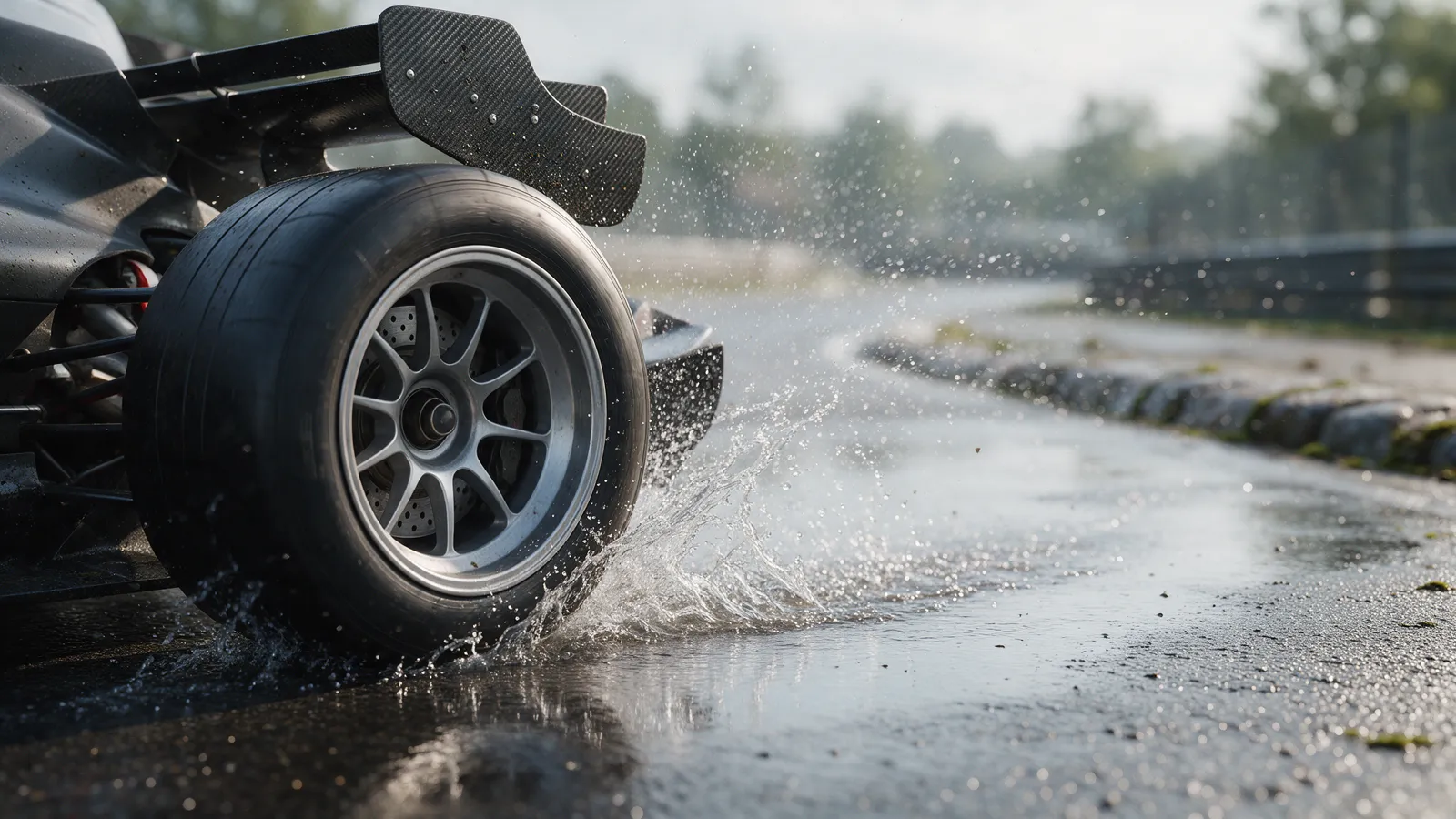
Formula 1 has three families of tyre for racing. Slicks have no tread and work when the track is dry. Full wets are the deep-grooved option for a properly waterlogged surface. In between sit the intermediates, which Pirelli describes as the answer to a changing or damp track.
The tread is made of blocks and channels. The channels move water away from the contact patch. The blocks have to grip and flex: too little flex and the tyre stays too hard to make heat, too much and it overheats. Intermediates are also softer than slicks, which is why they feel at home on a cool, wet surface and wear faster once the surface dries.
Put a slick on a wet road and the water has nowhere to go, so the tyre can start to aquaplane. That is the whole reason this family exists.
When do F1 drivers switch to intermediate tyres?
The industry shorthand is the crossover point, the moment at which the tyre you are on is slower than the tyre you could be on.
Pirelli gives a simple benchmark. Take a normal dry lap as 100 percent. When your slick laps reach about 110 to 112 percent of that, the intermediate becomes the faster option. A dry 1:30 lap becomes a 1:40 lap, and that is your cue. The same logic runs one step further: a similar jump from your normal intermediate lap time points to full wets.
It sounds tidy. It is not. A track dries in a line, not evenly, so one sector can be soaked while another is damp, and a rule that works on average lap time is slow to notice that. Pit walls tend to live in the gap between "the rule says box" and "the driver says it is fine", and that gap is where the best and worst strategy calls of the year come from. Crossover is the F1 term for forty people on a pit wall all saying "box" a lap too late.
How much water can an intermediate tyre move?
More than you would guess. Pirelli estimates that a single intermediate at 300 km/h disperses roughly 35 to 40 litres of water per second. A car at full speed on intermediates shifts about 150 litres per second. Move to the full wet and that roughly doubles.
The price is speed. Pirelli says average speed drops from around 200 km/h on slicks to around 180 km/h on intermediates. And if you are on intermediates when slicks are right, the gap can be five or six seconds a lap. This is why teams do not hold a driver on the wrong tyre out of caution. Being on the wrong tyre is expensive in both directions.
Why were intermediate tyres the story in the Singapore Sprint?
Because the weather made them the only sensible call. According to Formula1.com, a downpour before the 2026 Singapore Grand Prix Sprint left sectors one and three soaked and sector two damp, and every driver started on intermediates. The race began about half an hour late.
That sector split is the crossover puzzle in miniature. A damp middle sector and two soaked ones is the type of track where a slick would be hopeless and a full wet would be slow. Intermediates were the compromise.
The tyre-wear side showed up late. Formula1.com reports that Charles Leclerc told his team his intermediates were heavily worn in the closing laps. The likely explanation, and it is our reading rather than a team statement, is the soft-tread problem: as the surface dries, the blocks that grip in the wet overheat and wear.
The Sprint is a useful preview for the Grand Prix. If it rains again at Marina Bay on Sunday 11 October 2026, the same question returns over a longer race, with more laps in which to get it wrong.
What should you watch for in the next wet race?
Three things are worth tracking on the live timing. First, the gap between the first car to pit for the next tyre and everyone else: the first driver tells you where the crossover really is. Second, sector times: if one sector turns before the others, the average lap time will lag the truth. Third, who is on the older set of intermediates late, because that is where the track-position versus tyre-life trade is decided.
Put your Energy on the crossover call before the lights go out with GridRaces predictions, and follow every stop as it happens on GridRaces Live. New here? You can create a free account in a minute and play along from the next round.
Frequently asked questions
When do F1 drivers switch to intermediate tyres?
When the track is wet enough that slick lap times fall to roughly 110-112% of the dry pace, according to Pirelli's rule of thumb. At that point the intermediate is expected to be quicker.
What is the difference between intermediates and full wets?
Intermediates suit a damp or changing surface, while full wets suit a properly waterlogged one. Full wets move roughly double the water of an intermediate, according to Pirelli.
Why do intermediate tyres wear out on a drying track?
As the surface dries, the soft tread blocks are likely to overheat and degrade, which would fit with Charles Leclerc reporting heavily worn intermediates late in the 2026 Singapore Sprint.
Sources
Related

Antonelli vs Russell 2026: Singapore Tests the Mercedes Gap
Antonelli vs Russell through 15 rounds: eight wins to three, no DNFs to two, level on poles. What the Singapore GP back-row start means for Mercedes.

Singapore Sprint Result: Verstappen Wins After Russell Crash
Verstappen won the rain-delayed 2026 Singapore Sprint after Russell crashed and the McLarens collided. Here is what happened and what it means for Sunday.

Audi Singapore Livery Unveiled: Blue Shimmer for Marina Bay
Audi's one-off Singapore livery adds a blue shimmer to its Titanium Silver Grey car for Round 17 at Marina Bay on 11 October 2026.